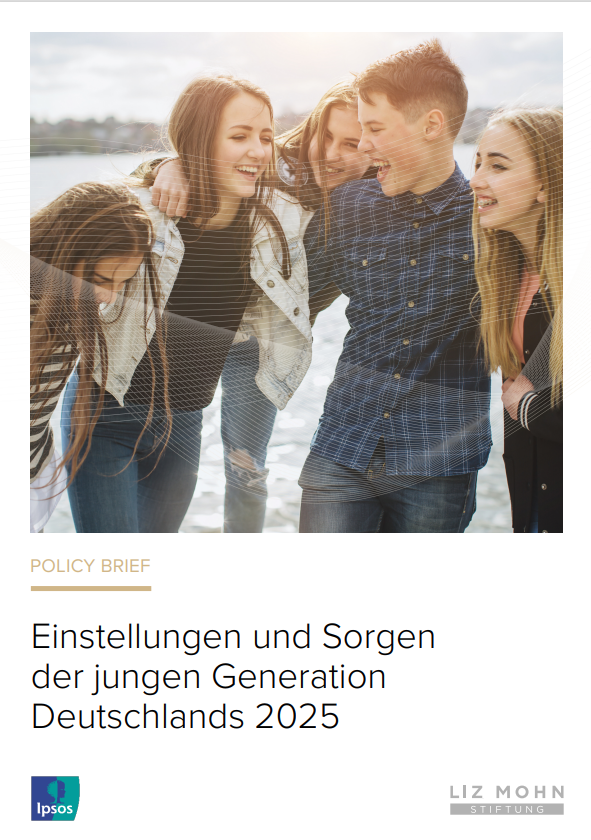
For the representative study “Views and Concerns of Germany’s Young Generation in 2025,” 800 children and young people aged 12 to 18 were surveyed. It clearly shows that politics is becoming more important for many young people: 45 percent of those surveyed say they are interested in political issues, and just as many regularly keep themselves informed about politics. Both figures are up 6 and 8 percent, respectively, compared to the previous year.
The multiple challenges of today’s world are also affecting children and young people. They worry about the death of a loved one, inflation, war scenarios, the threat of terrorism, and climate change. 82 percent of those surveyed feel that inflation has the greatest impact on their everyday lives. Nevertheless, a narrow majority is optimistic. 52 percent say they are satisfied with their own lives. The majority is rather skeptical about the future of Germany. Only 22 percent believe that Germany’s future will be better in three years than it is now. 62 percent are satisfied with democracy and 52 percent with how it works in Germany.
Instead of resignation, the younger generation is responding to this skepticism with political interest and increased social engagement (up 6 percent from last year).
Greater media literacy for a strong democracy
It is also clear that information behavior and news consumption are changing. Digital communication tools, and AI applications such as ChatGPT in particular, are increasingly being used for research and reading (60 percent) as well as for schoolwork (62 percent). However, AI also causes personal anxiety for more than a third of respondents (34 percent). Traditional media such as television and radio (56 percent), social media (58 percent), and close personal circles such as family and friends (60 percent) play a decisive role in obtaining information on political topics. The younger generation is largely aware of the influence that reliable information has. They consider the following measures to be appropriate for improving the functioning of democracy in Germany: learning how to deal with misinformation (45 percent) and more political content in the classroom (43 percent). The results suggest that political education and media literacy should be increasingly linked in order to respond adequately to the needs of young people and technological developments.
Nadine Lindemann, Managing Director of the Liz Mohn Foundation, emphasizes: “The younger generation is paying close attention to the world and wants to take responsibility. The growing political interest among young people is an encouraging sign. We should give young people a voice in order to win them over to shaping our social future together.”
With its youth study, the Liz Mohn Foundation is creating an empirical basis for understanding the attitudes and concerns of young people. The aim is to highlight their views, bring their perspectives into social discourse, and tailor programs and dialogue formats accordingly.
The policy paper „Views and Concerns of Germany’s Young Generation in 2025“ (in German) is available for download below.